






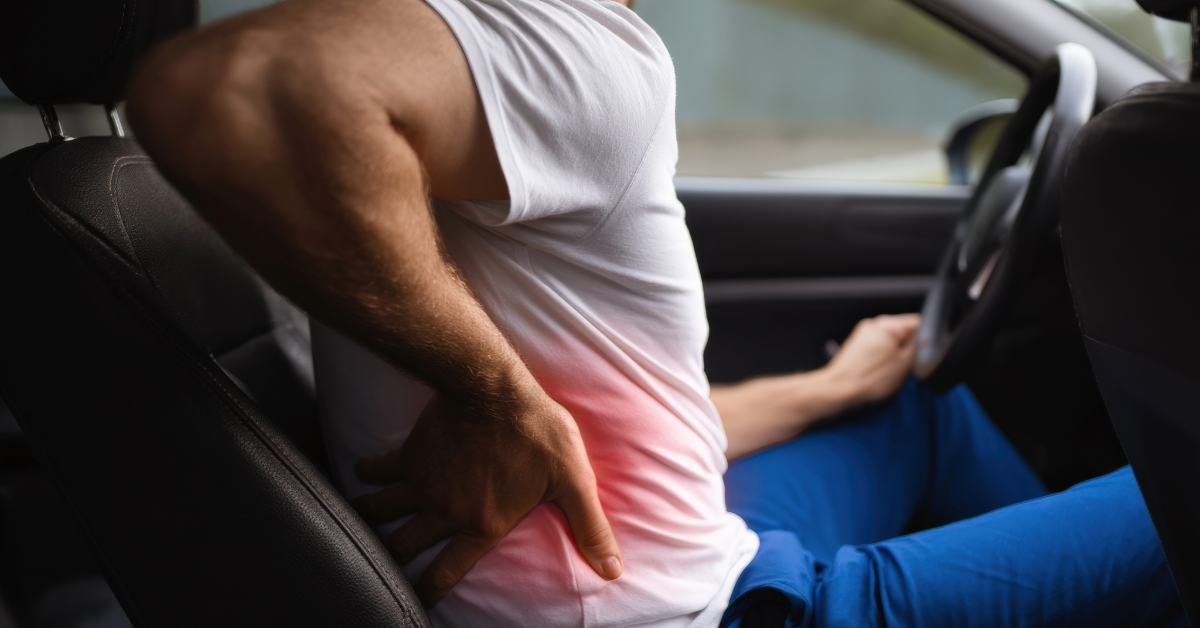
You finally pull into the driveway after four hours on the highway. You stand up, and your lower back feels locked in place. Maybe it loosens after a few steps. Maybe it still aches the next morning.
Lower back pain after driving is common, and holiday travel makes it more likely. Lab studies on long stretches of sitting find that somewhere between a quarter and half of people develop low back pain during one long sit. A few small changes to how you sit and when you stop can make your next trip a lot easier on your back.
Why does my lower back hurt after driving?
Sitting still for hours is the bigger problem, more than sitting itself. Your spine likes to change positions, and a car seat keeps you in one spot. During a long drive:
- Your lower back rounds. Many car seats let your hips slide forward and your lower back curve backward. Holding that curve for hours puts steady pressure on the discs and tissue in your lower back.
- Your hip flexors stay shortened. The muscles at the front of your hips stay bent the whole drive. When you stand up, they pull on the front of your lower back.
- Your back muscles never get a break. Small muscles along your spine keep working to hold you steady through bumps, turns and braking.
- Your discs lose a little height. One study found that the disc between the two lowest vertebrae in the lower back lost height after four hours of sitting without breaks. Brief position changes every 15 minutes kept that change from adding up.
Is it worse if I already have back pain?
It can be. People who already have back pain tend to feel it build faster during a long sit. If your back flares up every time you travel, that pattern is worth getting checked.
How do I set up my car seat to prevent back pain?
Take two minutes before you pull out of the driveway.
- Sit all the way back. Scoot your hips to the back of the seat so there's no gap between your lower back and the seat.
- Use lumbar support. If your car has an adjustable lumbar support, bring it out until you feel a gentle push in the curve of your lower back. If it doesn't, roll up a small towel or sweatshirt and tuck it behind your belt line. In a study of taxi drivers, the ones who used lumbar support regularly had about half the rate of back pain (18% compared to 34%).
- Lean the backrest back a little. Sitting bolt upright makes your back muscles hold you up. A slight recline lets the seat take some of that work.
- Move the seat close enough. You should be able to press the pedals all the way down with a slight bend in your knee, and hold the wheel with your elbows bent. Reaching pulls your back off the seat.
- Empty your back pocket. Sitting on a wallet or phone for hours tilts your pelvis to one side.
How often should I stop on a long drive?
Stop more often than you think you need to. Short, frequent changes in position help your back, which is why the 15-minute shifts in the disc study made a difference.
- Plan a stop every 1 to 2 hours, even if you don't need gas.
- Shift every 15 to 20 minutes while you drive. Adjust the lumbar support, shift your weight from one hip to the other, or gently rock your pelvis forward and back when it's safe.
- Move more as a passenger. You have more freedom, so change positions often and stretch your legs out when you can.
What stretches help back pain at a rest stop?
Give yourself three to five minutes at each stop. Walk first, then try these. Stop any stretch that sends pain down your leg.
- Walk for two to three minutes. A lap around the parking lot is one of the fastest ways to loosen a stiff back.
- Standing backbend. Stand tall with your hands on your lower back and gently lean back 5 to 10 times. It moves your spine the opposite way from how it sat in the car.
- Hip flexor stretch. Step one foot forward into a short lunge, tuck your tailbone under and hold for 30 seconds per side. Hold the car door for balance.
- Hamstring stretch. Rest one heel on a curb with your knee straight and lean forward gently from your hips. Hold for 20 seconds per side.
What if my back still hurts days after the trip?
Stiffness that fades within a day or two is common after a long drive. Keep walking every day, and use heat or ice to take the edge off. Not sure which one to use? Read our guide, [Ice or Heat? How to Pick the Right One for Pain].
Get your back checked by a physical therapist if:
- The pain lasts longer than a week or comes back after every drive
- Pain, numbness or tingling travels down your leg
- Your back also stiffens up after sitting at work or on the couch
- Pain wakes you up at night
Get medical care right away if you have numbness in your groin or inner thighs, trouble controlling your bladder or bowels, or back pain after a fall or car accident.
How physical therapy helps back pain from sitting
At Renew Wellness, your physical therapist looks at how you sit and move, and finds where your back stiffens up. Then they build a plan of hands-on treatment and exercises you can do at home or at a rest stop. Your exercises live in PhysiApp, so your plan travels with you.
- Every session is one-on-one with a physical therapist for 45 minutes.
- You don't need a doctor's referral in North Carolina or South Carolina.
- Renew accepts all insurances.
- Every Renew clinic is inside an O2 Fitness club, and you don't need a gym membership to be seen.
Not sure if you need physical therapy? Book a free 20-minute screening at any Renew clinic, including Durham, Morrisville, Greensboro, Winston-Salem and Wilmington.